
The Therapeutic Tool That Finally Unlocks Conversations About Grief
without clichés or awkward silences.
My name is Dr. Laura Bennett. In my 15+ years as a grief-focused therapist, supporting grieving clients has always stirred a mix of emotions in me...
Deep care, but also a sense of helplessness.
Even when offering presence, empathy, and solid technique...
Something often felt blocked.
Some clients would fall into silence.
Others stayed caught in narratives that tiptoed around the real pain.
And it was during one of those silent sessions that I realized...
Maybe what was missing wasn’t more words…
But a gentler pathway into emotion.
Grief doesn’t want to be rushed.
It doesn’t need a plan.
It needs permission...
To be felt, witnessed, and expressed safely.
And sometimes, what creates that space isn’t spontaneous sharing…
But the right question, at the right time.
Something the mind can receive before resistance takes over.
Why do questions work better than interpretations in grief therapy?
One realization I’ve come to through years of supporting grieving clients is this:
Naming pain too soon can interrupt genuine listening.
In the desire to comfort, we may (often unconsciously) slip into interpretations or reframing...
When what grief really needs is not explanation, but space.
That’s when I began replacing interpretations with questions.
Not clinical or investigative ones, but gentle, inviting ones.
- “What do you miss saying?”
- “What gesture of theirs still stays with you today?”
- “How did your body respond in the days following the loss?”
These aren’t rushed questions.
They don’t demand articulation.
They open windows...
And sometimes, those windows become doors to the beginning of healing.
It was from this need—for a gentle guide, a spark to start the conversation without invading the sacred space of grief—that I began to systematize the questions that worked. I transformed my personal clinical tool into something other therapists could use. This is how the Grief Deck was born.
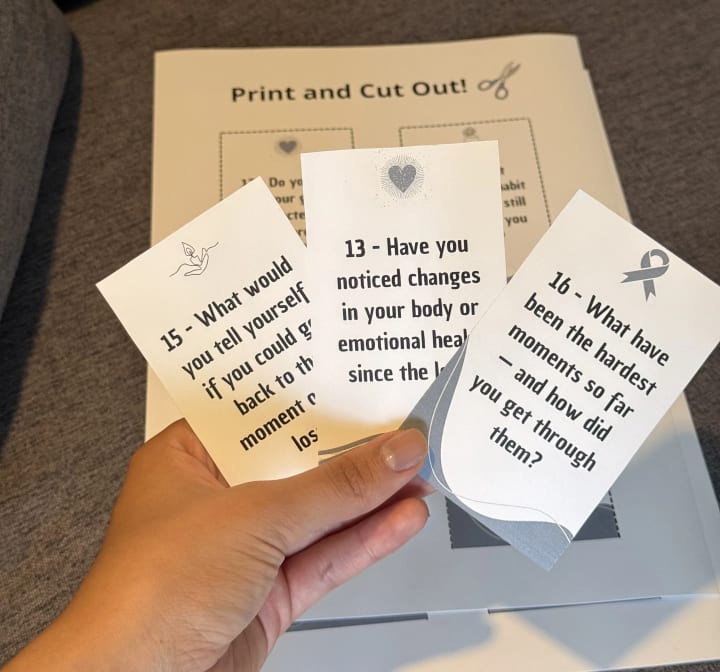

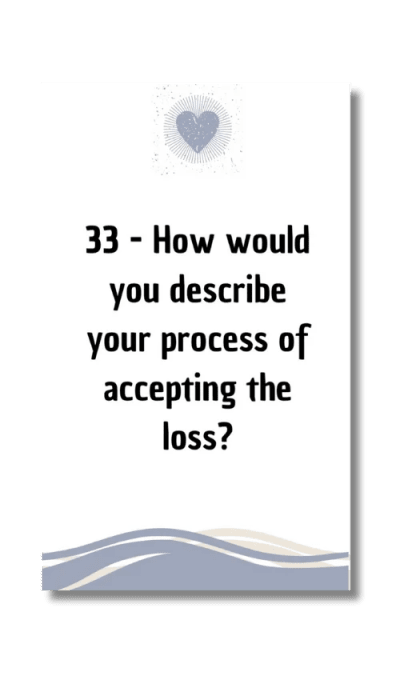

That’s the intention behind the Grief Deck...
A tool of 60 thoughtfully designed cards, created to hold space, spark reflection, and gently guide deeper conversations with grieving clients.
Each card offers a therapeutic prompt or reflective question...
Crafted to access emotion with care, whether at the start of a session or when words have run dry.
A therapist once told me something that stayed with me:
“I used card number 17 with a 29-year-old client who had been silent for three sessions.
She looked at the question, took a deep breath, and said: ‘I think I can talk about him now without feeling guilty.’”
It was one of the most moving sessions she had ever experienced.
Today, I use this deck in two main ways:
- ✦ At the beginning of a session, to gently open space for sharing
- ✦ In the middle of the process, when the client feels emotionally stuck
In both cases, the results have been powerful...
Especially with teenagers and adults experiencing recent loss.
“I used the deck for the first first time with a 42-year-old client who had recently lost her mother.
She seemed stuck, repeating the same phrases, as if trapped in the narrative of loss.
When I pulled a card that asked, ‘What do you miss hearing from her?’, she cried for the first time in our sessions and began sharing memories that had not surfaced before.
It felt like something finally unlocked.
And from that moment, our therapeutic bond deepened.”
This tool doesn’t replace presence.
It deepens it.
And it’s helped me facilitate more meaningful sessions...
While also helping me stand out as a thoughtful, up-to-date, and clinically grounded therapist.
The Grief Deck is available as a downloadable PDF:
 60 therapeutic question cards
- Clinical suggestions, usage tips & session ideas
- Suitable for both online and in-person sessions
- Designed for therapists working with grief, emotional processing, and relational loss
A single therapy session that doesn't advance because of an emotional block already costs the patient (and the therapist) precious time. Individual therapy tools can cost anywhere from $50 to $150. My goal, however, is not to create a barrier, but a bridge. That's why I decided to offer full access to the Grief Deck, including all 60 cards and the clinical guide, not for $97, not even for $47, but for a symbolic price that allows any dedicated professional to have access.
If this material resonated with you, and you sense it could support your work, here’s the link to explore the Grief Deck.
Originally created as a personal therapeutic resource, this deck is now available as a digital PDF for only $9.90USD. You can print it, use it in your sessions, and keep it as part of your clinical toolkit.
In a world that moves fast, being present is becoming rare.
Having tools that deepen care without pushing the process… is what keeps us human in therapy.
I hope this resource supports your practice as much as it’s supported mine.

This site is not a part of the Facebook website or Facebook Inc. Additionally, this site is NOT endorsed by Facebook in any way. FACEBOOK is a trademark of FACEBOOK, Inc.